
The National Anti-Profiteering Authority has ordered FMCG major Nestle to deposit Rs 73.15 crore with Consumer Welfare Fund for not passing GST rate reduction benefit to consumers. Refuting the charges, Nestle said the benefits largely have been passed on by way of reduction of MRP or by way of increase in grammage.

This could be the first instance when a consumer goods company would move court against NAA. The confrontation began after the government cut tax rates on over 175 items like toothpaste, shampoo, shaving cream and washing powder to 18 per cent from 28 per cent.
All GST anti-profiteering complaints would be dealt with by the Competition Commission of India (CCI) from December 1 as the extended tenure of National Anti-profiteering Authority ends this month, an official said on Tuesday. A notification in this regard is expected to be issued by the finance ministry later this month, the official added. The National Anti-profiteering Authority (NAA) was set up in November 2017 under Section 171A of Goods and Services Tax (GST) law to check unfair profiteering activities by registered suppliers.

Provisions in the Central GST Act say reduction in GST rates or the benefit of ITC must be passed on to consumers.

The investigation against HUL was initiated on the basis of an anonymous complaint. It alleged 'profiteering' of around Rs 535 crore between November 15, 2017, and February 28, 2018.
One of the grey areas is whether the anti-profiteering provisions can provide for a comparison of tax rates between the pre-GST and post-GST eras, says Niraj Bagri.

Experts said the builders will now factor in their losses arising from the removal of input tax credit when they pass on the benefits to end users while the latter may want the entire GST cut to be given to them.

Anti-profiteering authority puts Baba Ramdev-led company in the dock for allegedly not passing on benefits received from the reduced rate of taxation under the GST regime. Patanjali to respond to notice at January 28 hearing.

There have been complaints from consumers that the firm has increased the base price of products and then charged the lower GST rate, thereby keeping the MRP of products the same in pre and post tax rate cut.

National Anti-profiteering Authority to be set up for ensuring that customers get the benefit of GST

The Appointments Committee of Cabinet has named Ravneet Kaur, a Punjab cadre IAS officer of 1988 batch, as chairperson of the Competition Commission of India (CCI). Kaur will hold the post for five years or until attaining the age of 65. She is the second woman to serve in an 'economic regulator' role after Madhabi Puri Buch, who was appointed chairperson of the Securities and Exchange Board of India last year and the first woman to head the country's chief national competition regulator.

Experts point out that National Anti-profiteering Authority does not have the power to advise companies on depositing amounts voluntarily.

GST rate for petrol and diesel cars and hybrid vehicles is already at the highest bracket of 28 per cent plus cess.

The new form will only require a complainant to mention the product and GST identification number of the seller

To improve compliance, govt may introduce lottery reward for filing GST. The Consumer Welfare Fund, where anti-profiteering proceeds are deposited, will be used to reward the lucky winners on monthly and annual bases. The prize money, yet to be fixed, may run into several lakhs of rupees for the annual draw, and about Rs 50,000 for monthly draws.

The deposit has been made on account of the rate reductions approved by the GST Council in its November. The rate was reduced on items including shampoo, detergents, chocolates, beauty products, sanitary ware, leather clothing, cookers, stoves, after-shave, deodorant, detergent and washing power. Companies found it difficult to pass on the benefits to consumers immediately at the time of GST rate reduction owing to logistical issues.

Tata Starbucks had hiked the base price of one its coffee variant after the GST Council cut tax rates on restaurants from 18 per cent to 5 per cent with effect from November 15, 2017.

This meeting has led to the deferment of the Goods and Services Tax (GST) Council meeting by a day.

From a commercial standpoint, reducing the price of each SKU, particularly with a small MRP (Rs 5 or below) is often a challenge, including availability of legal tender below Re 1

The GST Council, headed by Finance Minister Nirmala Sitharaman and comprising representatives of all states and Union territories, will have its 37th meeting in Goa against the backdrop of economic growth hitting a six-year low of 5 per cent in the first quarter of the current fiscal.

The focus will be on tackling the unfinished agenda requiring immediate attention like tax structure for solar projects, uniform tax rate on state-organised and state-authorised lotteries, taxing non-potable alcohol besides certain changes in the law, extension for NAA and rate rationalisation.

Are we creeping back to controls on corporate decision making? Three moves over the past eight months reinforce this notion, says Kanika Datta.
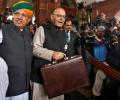
Pensioners, India Inc may get tax breaks in Budget

The move will help address apprehensions as well as potential disputes on various computational and transitional issues such as the loss of input credits and pricing that were bound to arise on account of the change.

As per the revised return filing timeline decided by the Council, for July, the sale returns will have to be filed by September 5 instead of August 10. Companies will have to file sale invoice for August with the GST Network by September 20 instead of September 10 earlier.

Assembly elections coming up in November and December could offer a window of opportunity to the government to make GST attractive through rate cuts.

The opposition parties vehemently criticised the new 'one nation, one tax' system having four different rates instead of a single rate adopted in some countries including the UK and Singapore.

Parliament on Thursday cleared the decks for the rollout of the historic Goods and Services Tax from July 1 as it approved four supporting legislations to usher in the one-nation-one-tax regime.
 © 2026 Rediff.com - Advertise with us - Disclaimer - Privacy Policy - Sitemap - Feedback - About us - Terms of use - Grievances